Tuesday, January 28, 2014

Snow Storm February 4th - 5th

I've been seeing discussion on the up coming snow storm for February 4th -5th 2014 for the Indiana region. During this post, I will give a brief synopsis of current model output. Due to the complexities of winter storm forecasting, these outputs can drastically change over the next few days. These images should be taken lightly. 

Model's

European

To begin, The European model is usually the most accurate in weather prediction. The European model depicts snow initiation at Tuesday 02/04/14 at around 8pm. It shows a vigorous snow swath spanning from south central to north central Indiana with snow fall rates around an inch per hour. Storm is expected to end around 8am.


Canadian

The Canadian is another highly sensitive model, it appears to agree with the timing of the snow event. Snow appears to be entering Indiana boundary around 8pm and dumping substantial snow amounts. Storm appears to end before 8am. Similarities can be deduced from swath path and width. Both models appear to be showing heaviest snow bands in central Indiana moving NE. Intensity of storm also appear to be in an agreement. 


Global Forecast System - American

The GFS, American model, disagrees with the Canadian and EURO models and shows the majority of the snow traveling through extreme southern Indiana and impacting Kentucky the most. It also disagrees with a widespread severe snow event and displays a more localized impact around the tri-state (Indiana, Kentucky, Ohio) location. An important factor is that timing and general location is roughly in agreement with the previous two models. 


Origins

You might be asking yourself.. Is this global warming? Are we experiencing global cooling?

These questions are normal, but this is nothing new. This is an example of a Colorado low. Colorado lows  originate from Colorado around the winter/spring time. Generally speaking, they bring about large amounts of winter precipitation with them. They can also be compared with Alberta clippers, which originate from Alberta Canada. It is normal for the heaviest snow band to be between 50-200 miles wide. Areas of heaviest snow can be seen where 700mb (A layer in the atmosphere) temperatures are between -10 and -5 degrees. Looking at the forecasted 700mb temps for this time period, it appears that the location meets the criteria as temps are between -10 and -5 degrees C. 


Conclusion

So as of now, conditions do look favorable for another snow storm beginning Tuesday evening 02/04/14 into Wednesday morning 02/05/14. All three major models are showing similar results of timing and intensity of the storm. Discrepancies occur on location of heaviest snow bands. Again, these forecasts are a week out as of currently. Literally anything can drastically increase or reduce these figures, so these totals should be taken with a grain of salt. 

References

www.weatherbell.com
www.theweatherprediction.com
www.twisterdata.com


Saturday, August 24, 2013

Monsoons and early morning weather in Tempe, AZ


Update

It has been a few weeks since I have updated this blog. To fill you in, my life has been crazy hectic! I recently moved to the sunny state of Arizona, and got a job as a Foreclosure Specialist at Nationstar. I have also found a great place to live and have been making new friends here in the valley. Arizona has turned out to be a real gem of a state. Such natural beauty, I can hardly wait to explore more of it once it cools down.

Monsoons and Weather

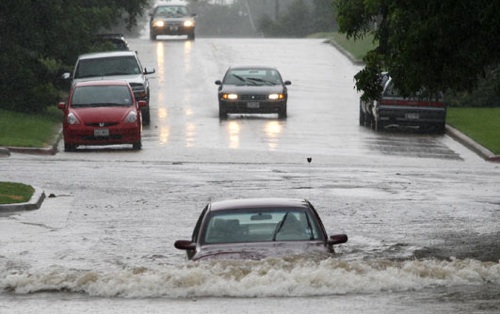
Naturally, coming from a weather background, I cannot help but notice all the weather that has been going on in the area. From torrential downpours, too extreme lightning, Arizona appears to be rich with weather activity. It is monsoon season! Scientifically speaking, monsoons are classified as a change in the predominant wind direction. There are two types of monsoons: dry and wet. Arizona usually experiences a wet monsoon. As you can see from the pictures that I posted, monsoons can have a big impact on the environment and us.


So what forces contribute to wind flow changes in Arizona?
How does the National Weather Service recognize when monsoon season has started?
Lets take a look!

Forces Contributing to Monsoon Season

In order to understand wind flows, you first have to understand thermodynamic principles. The laws of thermodynamics states that energy must flow from areas of high pressure to areas of low pressure. In meteorology, we are all about temperatures, dew points, densities, pressure, ect. So when we talk about pressure, we are really saying that areas of high pressure can be assumed to have cooler temperatures, and areas of low pressure can be assumed to have warmer temperatures. That is why in the summertime, it is always cooler on the floor of your home, and it is always hot towards the ceiling (hot air rises, cool air sinks. Think of the air as density). 

On a broader scale (scale, another important meteorology concept), Arizona begins to experience increasingly hot temperatures leading into the summer months. Factoring in what we learned earlier (hot air rises), a thermal low pressure system begins to develop over the Arizona region. This low pressure system is the beginning phase of the wind shift. As the low pressure system develops, the subtropical high pressure ridge pushes into the central United States. When this happens, we begin to see a change in wind flow. Instead of winds coming from the west north west, we begin to get a warm and moist southerly flow of air. Humidity (dew points rise) in the desert region increases significantly, and thus storms are able to develop. 


How to recognize monsoons and the National Weather Service's definition for monsoons

Recognizing the beginning of monsoon season is not rocket science. I'm sure all of us in Arizona are used to the 101 flooding or cars washing away. 
Diving into a more scientific approach, the NWS has stated that it classifies the beginning of monsoon season when dew point temperatures are above 50 degrees fahrenheit for more than 3 days. This illustrates that a direction change in the predominant wind has had a chance to impact the region. 

So lets take a look at current weather conditions (obviously we are in monsoon season, this is just to hammer home my point). This picture shows temperature and dew points (temperature being on top and dew point being on bottom).


As we can see, dew point temperatures are at 61 degrees. So we are still in monsoon season.

Just to further illustrate how well this works, the below picture is of a graph showing dew point temperatures and rainfall patterns in the Phoenix area.

Dew Point Temperatures:


Rainfall/Thunderstorm records:


Comparing the two graphs reveal that the higher percentages of rain and thunderstorms occur when the dew point temperatures are above 50 degrees.


To wrap things up, I hope you all enjoyed my insight into what monsoons are, the forces that drive them, and some defining meteorological characteristics. While everyone says forecasting for a desert is easy, it can still pose interesting weather situations. Thanks for reading!

Sources


http://www.spc.noaa.gov/exper/mesoanalysis/new/viewsector.php?sector=12#

http://weatherspark.com/averages/30108/Phoenix-Arizona-United-States

Wednesday, May 8, 2013

Classification Methods Summary

For an advanced cartography class, I compared poverty to education through four different classification methods. The expected result should show high poverty in locations with no advanced background in education and low levels of poverty in locations with advanced backgrounds in education. After displaying the results, we can see that locations with low education do not always correlate to high poverty. A good example of why this correlation is skewed, is due to large cities. The diversity of cities such as Phoenix, or Tucson, skews the data.